

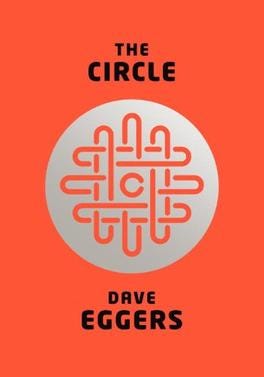
#/media/File:The_Circle_(Dave_Eggers_novel_-_cover_art).jpg)
Meta, the tech company behind Instagram, released a feature recently where users could tag any public profile in an AI prompt to generate AI images from the individual’s profile. Whether you were a public celebrity, an influencer, a small business, or just family, as long as you had a public profile, you could be used for someone else’s AI “artwork.” Furthering Meta’s goal to connect us all.
This headline came out as I was writing this book review. Dave Eggers published The Circle in 2013. The book is set in the near future, where our main character, Mae Holland, starts her new job at the tech company, The Circle. Along her journey, she discovers the history of The Circle, meets the founders, and becomes a central figure in their ultimate goal of “closing the circle.” For those who have not read The Circle, I will keep spoilers to a minimum as to not ruin the book’s plot. My aim in this book review, and hopefully future book reviews to come, is to shine a light on who we are and where we are today. The Circle, while written only 13 years ago, paints a dystopian future not too far from our present day.
Mae Holland, our central character in this story, comes from a fairly humble background. She is smart and driven, and enjoys an outdoor adventure kayaking in the fictional “Silver Bay.” Her friend, Annie Allerton, is a high-ranking executive at the company. Annie, being one of the ranks of “Forty,” is able to secure Mae a position in Customer Experience, thus rescuing Mae from her previous job at a local utility company. The company, The Circle, I would describe as a cross between Meta, Google, and Amazon. There are parties, dorm rooms, fitness centers, and shopping all available on The Circle’s campus. The culture viewed from the outside world is prestigious and a “dream” job for college graduates. Mae’s role is to handle customer questions, issues, and her survey results. If a customer’s survey results in 97 or 98 out of 100, each CS employee is prompted to follow up to try to push for 100. Mae’s drive leads to her rise in the ranks of her department. This is the start of Mae’s journey and not the only time she will be influenced by others ranking her. There lies another metric she must keep pace with: her social ranking inside and outside The Circle’s social media platform. You see, everything you do at work or socially is highly encouraged to be posted about, discussed online, and shared. As we find out later from Mae in a conversation with one of the founders, “Sharing is caring.” It is from this euphemism that we find the foundation of The Circle’s core philosophies.
A pivotal moment in the book is the introduction of a Circle product called SeeChange cameras. Introduced at a keynote hosted on the company campus, these cameras are akin to our modern-day Flock cameras, but more mobile and versatile. Extremely power-efficient, highly connected, and compact enough to be placed just about anywhere. The use cases expressed by the product leads and founders are infinite and, of course, noble. SeeChange cameras will be used to prevent crime, find kidnapped children, and aid the disabled to see places that they would never before be able to access. To illustrate the versatility of these cameras, one of the founders, an adventurer and climber, places a SeeChange camera on Mt. Everest. The introduction of these cameras is met with thunderous applause and welcomed by The Circle’s employees. This revolutionary product will soon allow The Circle’s mission to be realized.
The Circle’s mission of “closing the circle” is revealed to Mae by one of the company’s founders, Eamon Bailey. The goal for him and the founders presents a perfect world with perfect information. In the same conversation, he and Mae come up with three mottos that will lead the company going forward.
Secrets are Lies: This suggests that anyone who doesn’t disclose everything they are doing or thinking is effectively lying by omission to the rest of the world.
Sharing is Caring: This rebrands the collection of personal data as an act of generosity and community, claiming that your experiences belong to everyone and that withholding them is a rejection of others.
Privacy is Theft: It argues that if you have an experience or piece of knowledge and you don’t share it, you are “stealing” that experience from the rest of humanity, who could have benefited from it or enjoyed it with you.
These slogans are introduced following an incident in which Mae went kayaking alone without a camera or posting about it.
All of this leads up to the reveal of Mae making the decision to “go clear.” This involves wearing a SeeChange camera at all times, 24/7, broadcasting and streaming your life to the rest of the world. Up to this point in the book, only certain politicians have adopted the “going clear” lifestyle. It is seen as a good thing to “go clear,” and other politicians and world leaders are pressured by their constituents to “go clear” like their colleagues. Closing the circle is becoming closer to reality rather than a far-off fantasy of the founders.
“Privacy is theft,” “Sharing is caring,” and “Secrets are lies” all framed the idea that there is no good reason to have secrets or have things left to the veil of privacy. All things done in the dark have at best selfish reasons and at worst evil ends. Yet, while the book’s characters speak about this transparency as a positive development, the reader has an unnerving, unsettling feeling about it all. One encounter in the book equates all things being made known with making all of us akin to God. Knowing all things makes us the judge of all things, at all times. Hubris or not, all this transparency seems noble on its face. Yet it wrenches an unnerving gut check in us.
Who are we to pass judgment? In order to be a perfect judge, we must have a perfect filter to consume the “perfect information.” In the book, this evolves to the point of requiring everyone to be a part of The Circle’s social media site to vote and participate in society. The goal is to remove all friction in society, community, and democracy, which in turn lowers the barriers to entry for everyone. Again, on its face, this seems like a noble idea for an ideal world. With nothing hidden, do we believe humanity could bear that weight? Not to mention the arbiter of this “perfect information,” this “truth,” is a corporation with a profit motive, with its only accountability being its shareholders. Can perfect information be democratized without a central authority? Can that authority be trusted and benevolent without an incentive?
I think the nature of secrets is less about the motive of the secret. It lies more with who holds the power of that knowledge, and what they do with that knowledge. Humanity is not perfect, even with perfect knowledge. We can only see through the glass dimly. The Circle has a few people who have gone “clear,” starting with politicians, then moving to employees. Their whole lives are broadcasted for the world to see, 24/7, all under the veil of this idealistic world where all is known and nothing is hidden. No more lost children, no scandals, cheating, or crime. With everyone watching, who is going to step out of line? Yet, everyone who comes in contact with the “clear” individuals puts on a performance. A facade meant to cover themselves from the all-seeing eye of the crowd. This ends up isolating our main character from her friends and family, yet has her rise in the social rankings of The Circle. She is so connected and transparent that it makes her isolated and alone. She is unable to be alone, yet feels removed from everyone she cares about. She has outsourced her power, control, and identity to the masses. To be private is to have a self. To have agency is to control one’s solitude. If you give everything of yourself away to all, you lose yourself to their will and desires.
The tension between privacy and transparency cannot easily be distilled into good and bad parts. It lives in the tension for a reason. It’s our own agency that should decide what parts we give away. Regarding the question of democracy and a fully transparent government, I argue that removing friction in society is the last thing we need. If anything, we could use more. Friction slows the processes that run our systems. Sure, it may be inefficient at times, but it prevents any one side of the power structures from overwhelming the other. In order to have perfect knowledge, we acknowledge a perfect authority, which in my mind does not exist in this world. Increased friction brings about accountability, not less. Sure, we should know more about back-room deals and scandals, but not at the cost of discernment. Even if we could know all things, we could not pass perfect judgment upon it. It’s the fighting for the truth that brings about the equitable solution. Just being aware of circumstances does not give us perfect understanding or experience. We are finite creatures, and while we can do great things, we cannot be all things to all people at once. We are not God.
What is our relationship to technology? How much of our humanity are we willing to give up for safety and security? Are we able to see the world clearly even with perfect information? The Circle is a cautionary tale that answers these questions and exposes much more about our current relationship with technology than its future. I give The Circle four out of five stars.
‘If you give everything of yourself away to all, you lose yourself to their will and desires.’
This thought reminds me of Mae’s family and friends. They begin to see Mae as a different person, someone they do not recognize anymore. However, Mae strives for acceptance from them at all costs. She longs for them to see the world the way she now sees it, total transparency as a good thing, even if it comes to their own and her own detriment.